| From 2004 Begleithund (BH) Test Rules | | General regulations |
All dog owners are permitted to participate who can produce proof that they have already successfully performed the special knowledge test at a sanctioned event of the VDH comparable to the regulations of the VDH Handlers' License, or who produce the official certificate of knowledge. Entrants who are first time participants in the VDH-BH test and cannot furnish the appropriate certificate of knowledge must successfully pass the written test of verification of their knowledge on the day of the event before they may be tested in the practical part. Dogs of all breeds and sizes are permitted. The minimum age for dogs to participate in a BH test is 15 months.In order to be able to hold a BH test, there must be a minimum of 4 dogs participating in the trial. If the BH test is combined with other types of titles, there must be a minimum of 4 participants (for example, participants in VPG [Schutzhund], BH, etc.). The number of participants allowed to be judged in a single trial day varies from 10 up to 15 and is governed by the total number of the parts being judged, which may not exceed 30 [parts]. (BH tests combined with the written test on theory counts as 3 parts. Without the test on theory, the BH test counts as 2 parts.) Impartiality [Temperament] Test Before admittance to the BH test, all dogs entered are to undergo a temperament test, in which the identity of the dog is confirmed through checking of the tattoo number and/or chip number. Dogs that are not identifiable are not entitled to start in a trial. Evaluating the dog's temperament also occurs during the entire trial. Dogs that do not pass the temperament test are prohibited from further participation in the trial. If, during the course of the trial, a dog shows defects of character, even if it passed the first temperament test, the judge may disqualify the dog from the trial and enter into the scorebook the note, 'Temperament Test/Behavior Test failed". Evaluation Dogs which do not achieve 70% of the required points in Part A will not be permitted to participate in the Traffic Portion of the test.
At the end of the trial no point score is given by the judge but rather only a rating of Passed or Failed. The trial is passed if 70% of the attainable points are earned in Part A and in Part B the judge considers the exercises as performed satisfactorily.
The BH title is not a training title in the sense of the breed, show and breed selection regulations of a member organization of the VDH. A BH test may be repeated at any time. The outcome of each trial is recorded in the scorebook irrespective of the outcome. A) Begleithund Test on the training Field. Total Points:60 Each individual exercise begins and ends with the basic position. The dog sits directly next to its handler on the left side with its right shoulder at the handler's knee. Assuming the basic position is allowed only once at the beginning of each exercise. The handler is to stand in the basic position in a sportsmanlike manner. Standing straddle-legged is not permitted. The basic position at the end of an exercise can be the start position of the following exercise. Handler help is not permitted and if used, results in point deductions. Carrying something to motivate the dog, such as a toy, is not permitted. If a handler cannot perform an exercise correctly because of a physical disability, the judge must be informed of this prior to the beginning of the trial. If a handler's disability doesn't allow the dog to heel on the left side, the dog may heel in a comparable position on the handler's right side.
The judge gives the command to begin each exercise. Everything else, such as the turns, halts, changes of pace, etc., is carried out without direction from the judge. However, it is permitted for the handler to request these directions from the judge.
Praising the dog is permitted at the end of each exercise. Afterwards, the handler may take a new basic position. Between praising the dog and new start there should be a distinct pause (about 3 seconds). The dog must remain at heel between exercises. 1. On Lead Heeling (15 points). Command:" Heel" ("Fuss")
From the basic position at the command "Heel" ("Fuss"), the on-lead dog, wearing an animal rights approved collar or harness, follows the handler gladly. The lead may not be on the live ring of the collar.
At the beginning of the exercise, the dog and handler walk 40 to 50 paces straight ahead without stopping, perform an about turn and after 1 0 to 15 paces, show the fast and then slow paces of a minimum of about 1 0 paces. At a normal pace, they are then to execute a minimum of a right, a left and an about turn. The dog must stay with its shoulder at knee level on the left side of the handler. It must neither forge, lag or go sideways. The about turn is to be shown by the handler as a left about turn.
The command "Heel" ("Fuss") is permitted only when starting from the basic position and at the changes of pace. When the handler halts, the dog should sit quickly without help from the handler. The handler may not at this point change the basic position and especially may not move to the dog if it's sitting apart from the handler. During the heeling routine, the lead should be held in the left hand and must hang loose. At the direction of the judge, the handler and dog go through a group of a minimum of 4 people. The handler must halt at least once in the group. The group is to move randomly. Lagging, forging or deviating to the side by the dog while heeling, as well as pausing on the turns by the handler, is incorrect.
Group The heeling through the moving group is to be shown both on and off lead. While heeling in the group, a minimum of once around a person to the left and once to the right (for example, in the form of a figure "8") is to be performed. Once during each pass through the group, the handler must halt near a person. The judge may require the handler to repeat the exercise. Praising the dog is permitted only in the final basic position after leaving the group. About Turns (180) Two types of about turns are permitted, but they both must performed as left about turns. When carrying out the about turn, the dog can either go around the handler or the about turn is performed with the handler as a left turn. (The dog stays on the left side of the handler.) 2. Off Lead Heeling (15 points). Command:" Heel" ("Fuss") At the direction of the judge, the lead is removed while the dog is in the basic position. The handler hangs the lead over the shoulder or sticks it in his/her pocket. (In both cases, the lead goes on the side opposite from the dog, either over the left shoulder with the snap on the right side or in the right side pocket.) The team returns immediately through the group with the dog off lead, halting at least once in the group. After leaving the group, the handler briefly takes the basic position and then begins the off-lead heeling routine comparable to Exercise 1. The Required Trial Heeling pattern
Pattern may be worked with the turns in the opposite direction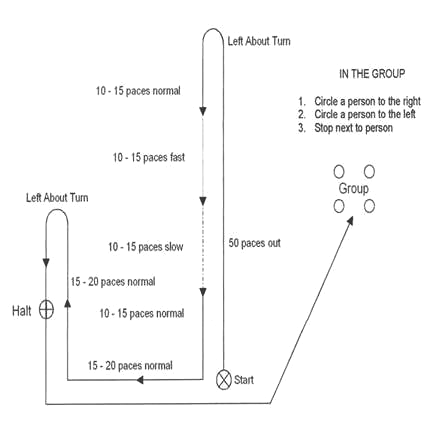
3. Sit Out of Motion Exercise (10 points). Command: "Sit" ("Sitz")
From the basic position and with the dog heeling off lead, the handler walks straight ahead. After a minimum of 10 paces and on the command "Sit" ("Sitz"), the dog must quickly sit, without the handler pausing or looking back. After an additional 30 paces, the handler stops and immediately turns towards the dog. At the direction of the judge, the handler returns to the dog and takes the basic position on the right side [of the dog]. If the dog stands or lies down instead of sits, there will be a deduction of 5 points.
"Sit"
Basic Position ---------------------------------- X -------------------------------------------------- Handler
10-15 paces normal minimum 30 paces normal
4. Down Out of Motion With Recall (10 points)
From the basic position the handler gives the command "Heel" ("Fuss") and walks straight ahead. After a minimum of 10 paces and on the command “Down” (“Platz”), the dog must quickly lie down. Without other influence on the dog and without turning around, the handler walks straight ahead another 30 paces, turns immediately towards the dog and stops. At the direction of the judge, the handler calls the dog. The dog should run to the handler quickly and happily and sit in front. At the command, "Heel" ("Fuss"), the dog sits next to the handler.
If the dog stands or sits, but the recall is perfect, 5 points will be deducted.
"Down"
Basic Position ---------------------------------- X -------------------------------------------------- Handler
10-15 paces normal minimum 30 paces normal
5. Down Under Distraction(10 points). Commands: "Down"("Platz"),"Sit"("Sitz") At the beginning of the obedience performance of the other dog, the handler downs the dog from the basic position at a place designated by the judge without leaving the lead or any type of article with the dog. The handler goes 30 paces away and stands at this distance with his/her back to the dog. During the Down, the dog must remain lying calmly. At the direction of the judge, the handler goes to the right side of the dog and at another judge direction, brings the dog into the basic position with the command "Sit" ("Sitz"). If the dog sits, stands or is restless, only partial points will be awarded. If the dog moves more than its own body length from the down position, the exercise is failed.
Restless behavior on the part of the Handler, as well as other hidden help is incorrect.
Bitches are to be downed separately, if possible.
A dog which does not earn a minimum of 70% (42 points) in exercises 1 through 5 is dismissed from further participation in the trial. B. Test in Traffic. General The following exercises take place outside of the training field in a suitable environment. The judge along with the trial chairman determines where and how the exercises in the public traffic area (streets, avenues or squares) will be carried out. Public traffic may not be impeded.
Because of their character, implementation of these parts of the test requires a considerable amount of time spent on them. The performance requirements may not be impaired by the superficial testing of too many dogs.
No points are awarded for the individual exercises in Part B. In order to pass these parts of the test, the total impression of the dog as it moves through traffic/the public is relevant.
The exercises described in the following are suggestions and can be modified by the judge to fit the local conditions. If the judge is unsure in the rating of the dog, he is authorized to repeat the exercises or to alter them. Order of Procedures 1. Encounter With a Group of People
At the direction of the judge and with the dog on lead, the handler walks along an assigned section of a street on the sidewalk. The judge follows the team at an appropriate distance.
The dog should follow willingly on the handler's left side on a loose lead with its shoulder at the handler's knee.
The dog must be indifferent to the pedestrian and motor traffic.
On the way, a jogger (someone assigned to do this, not a stranger) crosses the handler's path. The dog should appear neutral and indifferent.
The handler and dog walk further and enter a loose group of a minimum of 6 people, in which one person speaks to the handler and greets himlher with a handshake. At the handler's command, the dog must sit or lie next to the handler and behave calmly during the brief conversation. 2. Encounter With a Bike Rider
With the dog on lead, the handler walks along a street and is next overtaken from behind by a bike rider who rings a bell while passing. At some distance away, the bike rider turns around and comes towards the dog and handler. Beside the team, the bike rider rings the bell again. The traffic pattern should be set up in such a way that the dog is between the handler and the passing bike rider.
The dog should be indifferent to the bike and rider.
3. Encounter With Automobiles With the dog heeling on lead, the handler and dog walk past several cars. One of the cars starts up and as they pass one of the other cars, a door is slammed. As the handler and dog walk on further, a car stops next to them. The driver rolls down the car window and asks the handler for information. At the same time the handler commands the dog to sit or lie down. The dog must appear calm and unaffected by the cars and all traffic noises. 4. Encounters With Joggers or Inline Skaters With the dog on lead, the handler and dog walk along a quiet road. A minimum of two joggers overtakes them, without decreasing speed. Once one jogger passes, another jogger comes towards the handler and dog and runs past them without slowing down. The dog does not have to stay in heel position but may not bother either the jogger overtaking [them from behind] or the one coming towards them. During the encounters with the joggers, the handler is permitted to put the dog in a sit or down position.
Instead of the joggers, one or two inline skaters can overtake the handler and dog [from behind] and again coming towards them. 5. Encounter With Other Dog When being overtake by or meeting another dog with its handler, the dog has to behave in a neutral manner. The handler may repeat the command "Heel" ("FuB") or put the dog in the sit or down position during the encounters. 6. Behavior of the Dog when Tied Out Briefly and Left Alone; Behavior With Regard to Animals At the direction of the judge and with the dog on lead, the handler walks along the sidewalk of a moderately busy street. After a short distance and at the judge's instruction, the handler stops and attaches the lead to a fence, tie-out or similar. The handler goes out of sight into a business or entrance to a house.
The dog may stand, sit or lie down.
During the absence of the handler a passerby (someone assigned to do this) walks by with a dog on lead to the side of the dog being tested, at a distance of about 5 paces.
The dog that has been left alone must remain quiet during the absence of the handler. It must allow the dog being walked by to pass without acting aggressively (without pulling strongly on the lead or persistent barking). At the judge's direction, the dog is picked up. |